Posted by Michele Mele 01 February 2026
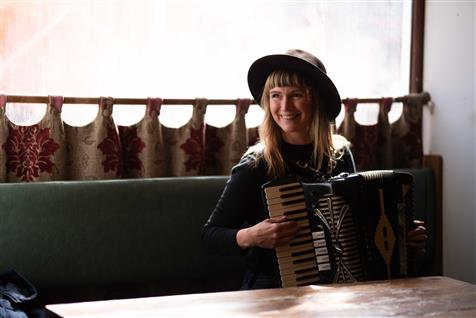
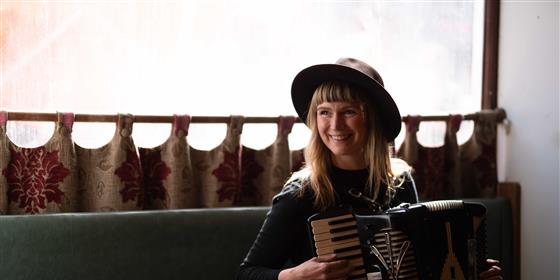
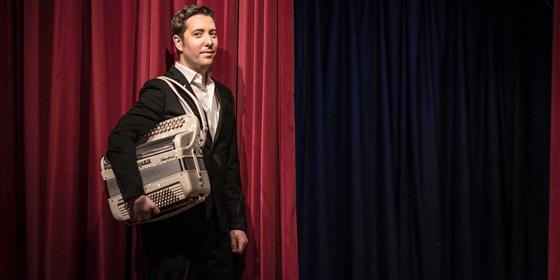
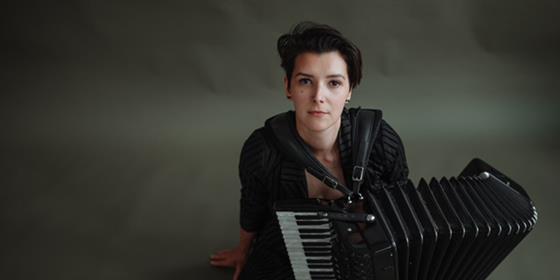
Clementine Lovell is an English singer, songwriter, and accordionist, whose career has spanned professional opera to the folk and traditional scene. Her music is deeply rooted in the stories and scenery of Herefordshire and West Cork, blending British and Irish elements with more contemporary and classical influences.
After taking opera to some unusual stages like caves and pubs, she took her accordion and gathered ten songs, some original, others self-penned, for her debut album Westbound, a striking collection of delicately crafted lyrics about people, historical events, and memories connected to the places of her life, all delivered by her distinctive shimmering soprano voice. This release has been shortlisted for the 2025 Bright Young Folk Readers’ Choice Award and won the Fatea Awards Debut Album of 2025.
She has been so kind as to answer a few questions for Bright Young Folk readers.
How did your musical journey begin?
My family holidays were to the West of Ireland and I was drawn to Irish traditional music from a very young age. I began singing in music sessions in the pubs there from around 9 years old and started to learn the accordion. My parents were not musical but they loved music and had a large record collection that included a lot of English folk music, and folk rock/revival. That was the soundtrack to my childhood, and influential on my sound.
Who were the most influential people to your artistic development?
My voice is strongly influenced by folk singers such as Joan Baez and Sandy Denny who I listened to from an early age. I started to learn accordion because of Rose Barnett, a local musician in Glengarriff, West Cork who would perform music in the pub every night with her husband John. They both encouraged me to get up and perform, and my song ’John Barnett’ immortalises him and their story.
Collaborations have been a very important influence in my development as a folk artist, including with pianist and composer James Keay, my producer Marion Fleetwood, and my trio Carmen Ruiz Vicente and Duncan Menzies. There are many other musicians who have inspired me and became part of my musical journey.
What has been the toughest challenge in transitioning from opera to folk music?
It wasn’t really a transition because folk music was there all along, long before my work in opera. I learned and performed folk music from an early age, it is in my soul, but I first worked professionally in the classical sphere.
I spent many years working as a producer in opera and artist development. One of the biggest challenges was making a decision to give up my work as a producer and allow myself to explore creating my own music professionally. I had built a career as a producer and facilitator and it felt like a big part of my identity, but the creative drive to make music was so strong and I am so glad that I followed it.
Writing songs, developing my sound, and recording and releasing my music into the world feels like the most true to myself I have ever been, and it fills me with joy.
How does natural landscape influence your creative process?
The places where I grew up have shaped me as a person and as an artist, and I use imagery from these landscapes in my songs, for example the frosty fields and apple orchards of Herefordshire which feature in Land Army Girl, and the rugged coast of West Cork which is the backdrop for my songs Westbound and Here A Moment.
When I worked at Britten Pears Arts in Suffolk the huge open horizons of sea and sky opened something in me and allowed me to begin the process of writing songs and exploring my creativity as an artist. I’m currently based in London but frequently feel a need to get out in nature, which inspires me and allows me to come back to the centre of myself.
What is the track of Westbound that best represents your musical journey so far?
I don’t think I can pick one track, as I think all the tracks on the album reflect this. It brings together my influences of both English and Irish folk music, and tells the stories of the people and places that shaped me and which are all part of that journey. All of the musicians who play on the album have been an important part of my musical journey and it was very meaningful to collaborate with them on it because of this.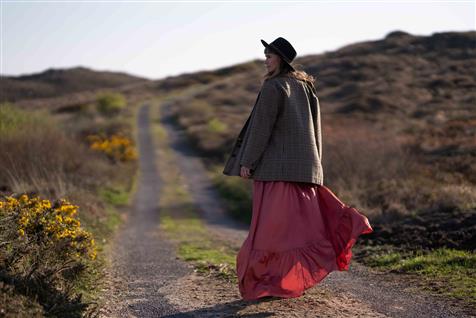
You are an operatic soprano that also plays the accordion; are you trying to subvert stereotypes about folk artists and their versatility?
I don’t think I’m consciously trying to subvert it, I am just writing and performing from my heart and being as true to my own sound as I can. I do like to explore however, and I’m not afraid to bring different musical influences into my work. I’m in the process of recording an EP of new material which includes elements of contemporary classical, electronic and experimental music. It’s a slightly new direction for me but I didn’t set out to do it consciously.
The songs just started coming out and I was excited by the idea of using effects pedals with my accordion to create interesting and atmospheric sounds. I suppose this is a kind of subversion, marrying this kind of soundworld with stories and songs rooted in folk and a vocal which at times feels more classical. I’m interested to know what people are going to make of it!
You are also an archaeologist and the grand-daughter of Sir Bernard Lovell, the famous astronomer. Do you feel your passion for human history or your family association with the infinity of space have influenced your music?
Oh definitely. A big part of my music is about telling people’s stories and exploring what it is to be human, and also about our place in time and space. My song Here A Moment is about making the most of the time we have on this beautiful earth, whilst telling the true story of four retired fishermen in West Cork who met with tragedy one day out at sea. On the EP there is a track called The Death of an Ordinary Star which uses imagery from space to explore change and loss, the need to make sense of things in our lives and be true to ourselves.
I do wonder what my grandfather would make of the song, and I like the connection to his legacy in my words. He was a classical purist, a pianist and organist, and didn’t really approve of any other genre of music. One of his favourite stories was about how Bryan May came to have an interview with him at Jodrell and it got down to Bryan and one other candidate. He couldn’t decide which one to give the job to so he asked them about their musician tastes. Bryan May said he played electric guitar, and he didn’t get the job. I inherited my grandfather’s piano and write many of my songs on it now.
What are your plans for the future?
It’s been a very exciting start to the year, as my album Westbound just won Debut Album of 2025 in the Fatea Awards. I was nominated alongside Jenn Butterworth and Cole Stacey, so even that felt phenomenal to be up there with such fantastic artists. I plan to release my EP in March, and am in the final stages of editing and mixing the three tracks. I’m working with a new collaborator on these - a multi-instrumentalist who also has a background in electronic music - and with Marion Fleetwood and Paul Johnson who produced and recorded Westbound.
I have also begun co-writing with the wonderful folk artist Daria Kulesh, and we are going to record our song You Bear in February which we plan to release as a single later this year. It tells the story of two women, separated by time and place but suffering the same shame and indignities due to their gender and circumstance. We are currently exploring the idea of a broader project around the song, plus the possibility of a mini tour together in the autumn.
I also have lots of new material that could form part of a second album, so I will continue writing and working on more songs for this and explore what direction that could take. I’m also on the line up for some of the folk festivals this summer, including Bridport and Purbeck Valley Folk Festival, so I hope to bring my music to new audiences. I feel excited about the possibilities ahead, and the creativity that is blooming inside me.
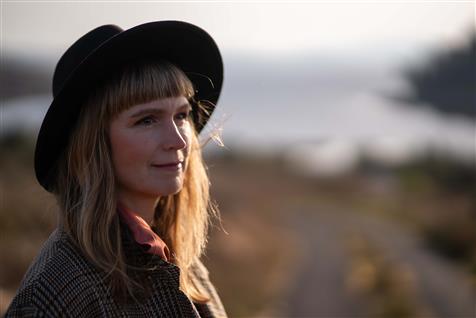
Photos by Donal Glackin
See all of Bright Young Folk's text interviews.